

The Rundown
- AI agents are autonomous systems that perceive, reason, act, and learn to accomplish a set goal with minimal human intervention.
- In the right hands, AI agents can be valuable tools for expediting tedious tasks and managing vast datasets, but they’re not a substitute for human expertise.
- AI agents have the potential to completely disrupt search processes by creating hyper-personalized and action-oriented responses, moving beyond information delivery and into real-time execution.
- The rise of AI agents may require that we all adapt SEO strategies to emerging technologies, potentially sooner than you think.
What are AI agents, and how do they work? Sixty-seven percent of small business owners and marketers use artificial intelligence for SEO1, so it’s no surprise that we’ve been getting this question frequently.
Artificial intelligence agents are autonomous systems that can streamline tedious SEO processes, such as analyzing vast datasets, keyword research, and site audits, with little to no human intervention required. They’re the closest thing to living software that exists.
It’s easy to imagine AI agents in SEO as something out of a sci-fi flick. Not only do we have the intrigue of artificial intelligence, but now they’re agents, too? That sounds pretty cool on paper, but in practice, they’re essentially just better software. No, the machines aren’t sentient…yet.
Although Kurzweil’s singularity hasn’t quite been reached, there’s no denying the impact of AI in the digital marketing field and the world at large. Roughly 72% of businesses used AI in some capacity in 2024, and around 50% used AI across at least two functions.2 AI is exploding in 2025, so there’s no doubt those numbers will continue skyrocketing this year and beyond.
So, are AI agents in SEO the next evolution of what will eventually become a Skynet-like system that nukes poorly optimized sites into oblivion, or are they just helpful tools for streamlining workflows? Sorry doomscrollers, but we’re leaning toward the latter. With that said, the rise of these agents brings revolutionary implications for the future of search.
Table of Contents
Visualizing the Role of Artificial Intelligence Agents
Need a visual? Since we’re talking about agents, let’s go ahead and use one of the most popular: Tom Cruise’s character, Ethan Hunt, from the Mission Impossible movie series.
This chain of command illustrates the respective roles of human users, LLMs, and AI agents in SEO and other fields.
- The Human User: The Impossible Missions Force (IMF) is the agency that gives the Director the mission.
- The LLM: The Director of the IMF delivers the mission to Ethan (this tape will self-destruct in 5 seconds…).
- The AI Agent: Ethan executes the mission based on the instructions.
Let’s go ahead and get real meta with it:
- The human user wrote the movie’s plot.
- The LLM is the director of the movie.
- The AI agents are the film crew members who create the movie.
Frequently Asked Questions
Here are quick answers to questions you’ve been asking. We’ll dive into the nitty-gritty details after, so don’t worry if you don’t find the answer you’re seeking.
What is an AI agent in SEO?
AI agents are autonomous systems that are equipped with resources and instructed to achieve a specific objective. In the context of SEO, they can be used to streamline and automate processes such as data analysis and report generation.
How do they work?
Artificial intelligence agents can perceive, reason, act, and learn. They’re similar to LLMs (large language models), but they’re more goal-oriented and have particular use cases.
What’s the difference between AI and AI agents?
Traditional AI models use pre-trained data to generate answers. AI agents can perceive their data-based ecosystems, analyze that data to gain a deeper understanding, perform relevant actions, and learn from and improve upon their processes.
AI agents can be utilized in SEO and other tasks with minimal human intervention, whereas traditional AI models require ongoing human interaction.
Is ChatGPT an AI agent?
No, although ChatGPT (and other LLMs) can respond to prompts and act as a virtual assistant in some areas, it’s not autonomous. It cannot learn from its interactions and handle incredibly complex and hyper-specific workflows.
The Impact of AI Agents (in the Present)
What are AI agents, and how do they work in 2025? What you may not realize is that they’re already extremely prevalent.
88% of companies have artificial intelligence agents on their radars or in their workflows. Specifically, 51% of businesses are researching them, and 37% have already started experimenting with them.3
If you think Google and other tech giants aren’t already exploring ways to use agents to change the search game, you’re in for a rude awakening when your SEO falls flat.
The Robots Aren’t Replacing Us
Before we get into the nuts and bolts of our altruistic, almost-alive software companions, it’s important to note that we’ve always prioritized the irreplaceable value that humans bring to the table. Our AI policy is that AI tools can be advantageous when used responsibly and effectively. However, they’re just that: tools.
Keeping up with emerging technologies is at the core of what we do. AI agents in SEO aren’t replacements for SEO specialists; they’re tools that can expedite tasks that don’t require a human touch. They’re able to process data at a speed and scale that our comparatively feeble brains can’t fathom. It would be foolish not to take advantage of that immense power, right?
The problem is that we will inevitably see a new breed of SEO charlatans selling virtual snake oil. AI agents make it possible to achieve measurable results without the grand finale.
Black-hat SEOs will be billing clients for pushing a button. As more and more fly-by-night SEOs start using AI agents in SEO, an industry that’s already overrun with scammers is going to become even more challenging to navigate. And just because AI agents can’t replace the proper specialists, it doesn’t mean they won’t reshape the playing field in the future.
AI agents can’t replace strategy. That’s where we come in.
Future Implications of AI Agent Infiltrations
While there are already AI agents in SEO, we haven’t yet seen their final form. In the context of search engine optimization (and AI SEO, for that matter), the impact of AI agents has the potential to be incredibly disruptive.
As mentioned, bottom-tier SEOs will be able to fool unsuspecting clients more easily. On the other hand, skilled SEOs will be able to work faster and on a larger scale. However, we’re still thinking in the framework of the current search ecosystem.
Today’s LLMs still function similarly to traditional search engines, but with a more conversational nature.
- The human user asks a question.
- The LLM generates a response.
- The human user clicks a link or moves along.
While AI-driven search often leads to zero-click searches, the underlying concept isn’t entirely revolutionary.
AI agents in SEO can be used to target both traditional and AI searches. But what happens when AI agents are no longer pawns on the chessboard, but players themselves?
It’s only a matter of time before these niche tools are widely adopted and become ingrained in search-based ecosystems. One can only imagine that optimizing for a hypothetical Google Agent would look very different from today’s long-established strategies.
For example, let’s say we ask Google to plan a trip to Philadelphia, including visits to historical attractions and a few kid-friendly spots.
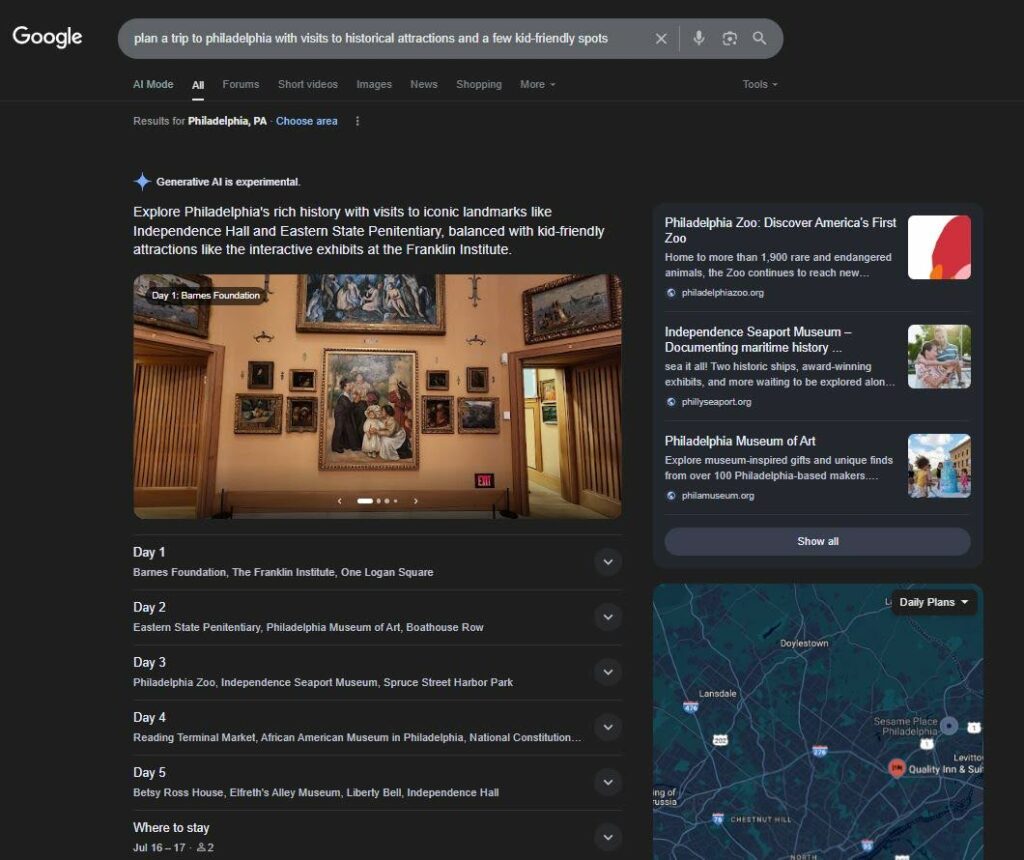
We get a basic, surface-level itinerary with recommendations based on authoritative websites and past searches. That’s impressive, but traditional SEO, with or without AI agents, can still be used to get featured in that overview.
A few years from now, Google Agent could go far, far beyond just recommending the most popular attractions. It could recommend hyper-specific destinations based on your budget, preferences, group, and other factors. But deeper personalization is just the start.
Google Agent wouldn’t merely provide recommendations. It would execute the entire mission.
It could act as a personal concierge, contacting every hotel in the area to find the best rate and then booking the room. It could purchase event tickets, make restaurant reservations, contact local friends you plan to visit, and essentially act as an autonomous liaison throughout every step of the planning phase, as well as during the trip.
So, how does this advanced hypothetical search model relate to AI agents in SEO?
In this speculative ecosystem, you wouldn’t be optimizing to get your link featured prominently in AI Overviews or get cited by LLMs to drive brand awareness. You would be optimizing to convince autonomous digital concierges to take action on your behalf.
Right now, Google recommends the Philadelphia Zoo. But why would the hypothetical Google Agent recommend the zoo if you don’t love animals? When every search interaction is granular, and algorithms are extensions of the searchers themselves, how do you capture the top spot? Will your go-to AI agents for SEO stay loyal, or will they go rogue?
Ways to Future-Proof Your Business
For now, we’re only speculating about how AI agents could fundamentally reshape the digital landscape as we know it. However, as we’ve seen already, AI evolves fast. Taking steps to future-proof your business now is far from premature. Here’s what that could look like:
Establishing Authority
Now is the time to cozy up to LLMs and earn their trust. The goal is to become the go-to, preapproved brand when a relevant query is asked.
Updating and Improving Content
In the realm of AI agents in SEO, schema markup may not cut it. The agents will likely prioritize websites that have significant quantities of comprehensive, authoritative content and vast, well-structured datasets.
LLMs may seem omniscient, but don’t forget that they’re still using human information (although AI cannibalism and regurgitation will likely occur, too). Top-tier content will be more critical than ever.
You’ll need to produce expert blogs and detailed product descriptions, along with critical data such as transparent pricing information and machine-readable lists of product features and specifications. The AI agents must be able to find the full scope of all relevant details faster than the blink of an eye.
Catering to AI (Not Just Humans)
Today’s websites are, understandably, designed for humans. In the future, you may also need to cater to AI agents as part of your SEO strategy. This could involve building AI-centric APIs (Application Programming Interfaces) that allow the agent to not only locate relevant information, but also take action.
By lending the agent a helping hand with the grunt work, you’re positioning your website as the go-to for interactions that manifest as real-world results. It’s not just about providing information about a product or service; it’s about providing a pathway for the agent to convert on the searcher’s behalf.
Advertising to AI
Let’s get back to the basics: what are AI agents and how do they work? They’re helpers. They do what their human tells them. Currently, we target our advertising to people because they’re the ones shopping. As the concept of AI agents in SEO evolves, these agents will likely handle much of the shopping.
Bots don’t care about catchy slogans and fancy logos. These digital concierges would exist to provide their humans with the best possible results. While traditional advertising wouldn’t disappear, it would evolve accordingly.
For example, your website could offer a discount code exclusively for purchases made by an AI agent. Maybe you’d partner with a specific LLM. Perhaps you’d even give the AI agent a commission for each sale! If nothing else, your ads must convey why the agent prefers your brand over others.
Be Ready for the Impact of AI Agents
AI agents in SEO sound scary, but they don’t have to sabotage your company’s future. The rise of AI agents could mean a surge in revenue if you approach the mission with the right intelligence agency on your side. We’ve navigated countless shifts in traditional and AI search, and we always come out on top.
For now, we’re in surveillance mode. We’re already embracing this emerging technology in ways that enable us to work more efficiently, without compromising the peerless quality of our work. We’re also strategizing ways to help our clients capitalize on AI agents in SEO.
Take a look at our reviews and case studies to gain a deeper understanding of the tangible value we bring to our clients. Contact us now to start planning the next mission.