
The Rundown
- Odoo: Odoo CRM’s modularity shines for businesses prioritizing extensive scalability and customization, and the mobile ERP system is great to have, too. At $7.25/user/month, it’s also the most affordable option.
- SuiteCRM: SuiteCRM offers extensive customizability in exchange for a much steeper learning curve.
- OroCRM: OroCRM lacks the support for third-party integrations we’ve seen in other competitors, but it’s one of the best open-source CRMs for B2B brands prioritizing omnichannel growth.
- Vtiger CRM: Vtiger is relatively more affordable than SuiteCRM and OroCRM. It’s easy to build with and comes with built-in automation workflows for sales and marketing tasks.
- EspoCRM: EspoCRM is lightweight and great for smaller teams who need an affordable CRM with self-hosting options. The extensive community-built third-party integration support is a great bonus.
Open-source CRMs are affordable, incredibly flexible, and can be designed to work for your business. If you’re reading this, you’re either a developer looking to try out their skills with a free CRM, a business owner who has already tried a bigger CRM and is ready for something more flexible, or someone looking for a small business solution that requires little to no technical expertise.
Whichever camp you fall into, you’ll find the answers you’re looking for with this open-source CRM comparison.
Table of Contents
Frequently Asked Questions
What’s the best open-source CRM?
There is no single best answer to this question. Different open-source options each have their own strengths, and the right fit will depend on your needs. For example, Odoo CRM only charges $7.25/month but also has strict storage limits. Consider getting a CRM integration expert to find the right fit for your brand.
How is open-source CRM software different from commercially available options?
Open-source CRM is usually cheaper and more flexible than most commercially available options. In exchange, many open-source options require a bit of technical know-how to set up, while bigger alternatives like Zoho and Klaviyo CRM can be deployed quickly out of the box.
Can I implement an open-source CRM myself?
You can, but we strongly recommend working with a CRM integration expert like Coalition Technologies to implement an open-source solution instead. Many open-source CRMs lack adequate documentation, and even the smallest error during deployment can be time-consuming to fix. An expert can help you get started quickly and use your CRM’s strengths to grow your business.
Can I integrate other business tools with open-source CRM software?
Absolutely. Most open-source CRMs support third-party integrations, but the process can vary a lot based on what you’re working with. SuiteCRM offers extensive API integration support, but requires some technical expertise. Vtiger, on the other hand, features built-in support for tools like Mailchimp.
Why Go Open-Source At All?
The best open-source CRMs offer strong alternatives to vendor solutions loaded with fluff, including features you don’t need and probably don’t want to pay for. Instead, you’re getting an easily scalable and more affordable open-source CRM software that grows as you do. Let’s take a closer look at those advantages:
- Cost-Effective: Bigger CRMs typically involve expensive licensing fees, while open-source options like OroCRM and EspoCRM have little to no upfront costs. If you’re eager to dodge those five-figure annual contracts, you’ve come to the right place.
- Customizability: As you’ll see in our open-source CRM comparison, most of these solutions offer virtually unlimited customizability. This is perfect for businesses that want to build a CRM system around their and their clientele’s unique needs.
For example, a real estate business could build a custom workflow tracking client viewings and integrating local market data. 45% of businesses report fast and impactful improvements to sales revenue after deploying effective CRM software, and customizability plays a huge role there. - Freedom: Picking open-source CRM software frees you from restrictive vendor lock-ins. You retain full control over your data and don’t have to worry about things like migration charges. This freedom also applies to considerations like hosting solutions. Go with the cloud or keep it on-premise, it’s your call.
Finding The Right CRM
Pricing
According to expert estimates, the average CRM plan from a top provider costs around $67 per month. That’s a far cry from the prices we’re seeing from the best open-source CRMs.
| SuiteCRM | OroCRM | Odoo CRM | Vtiger CRM | EspoCRM | |
| Pricing | Approximately $167.98/ month | $116/user/month | $7.25/user/month | $30/user/month | $15/user/month |
Odoo comfortably takes the lead as the most affordable open-source CRM software here. You can’t go wrong here if pricing is your biggest consideration for picking open-source CRMs. That said, there are a few factors worth taking into account before you make a final decision. We’ll learn more about that in the next section.
Features
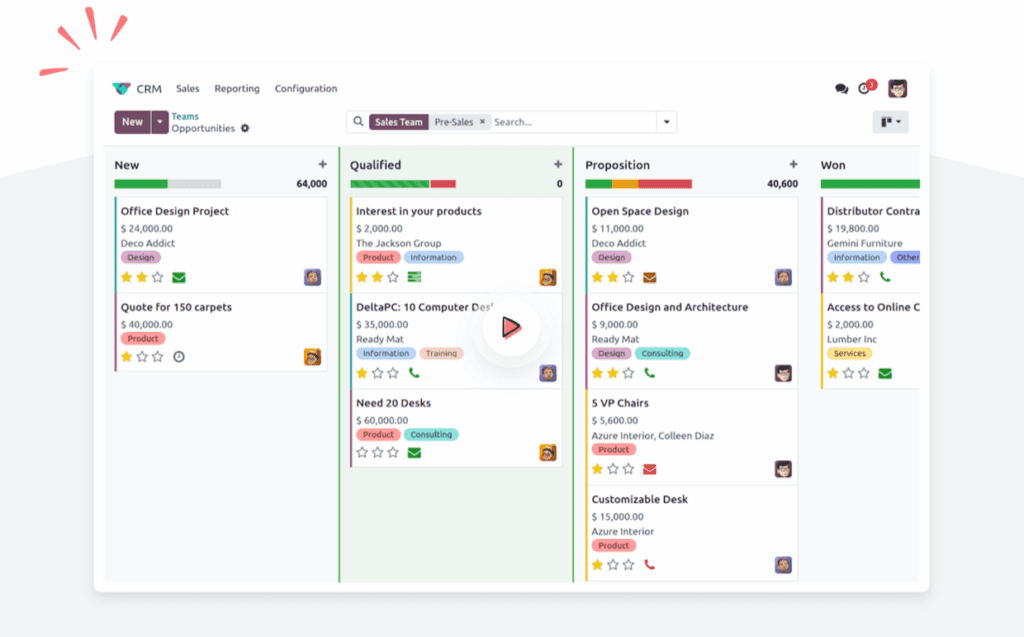
Odoo CRM (4.1 Stars/139+ Reviews)
Let’s start with Odoo! Along with being the most affordable CRM on our list, it also comes with the most features. Let’s make a quick list.
| Pros | Cons |
| One of the few open-source CRMs to include a mobile ERP system app to manage leads, sales, etc. | The free plan is incredibly limited |
| Features an extensive app marketplace like Zoho | Requires a ton of technical expertise since developer documentation isn’t very detailed |
| Features a modular architecture that’s easy to develop with | UI isn’t as intuitive as some competitors |
| Built-in campaign automation | Significantly larger codebase than most alternatives |
| Includes real-time reporting and analytics tools | |
| Reliable community support |
SuiteCRM (4.2 Stars/91+ Reviews)
If the steep learning curve of certain open-source CRM software is a pain point for you, SuiteCRM might be more your speed. This is one of the best open-source CRMs in terms of developer-friendly documentation and community support.
| Pros | Cons |
| Extensive developer documentation | Outdated UI (this CRM was released in 2014) |
| Highly customizable | No mobile support |
| Large and helpful community support | Performance isn’t up to par |
| Can easily integrate with third-party tools | |
| Offers self-hosting (no data storage limits) | |
| Basic email marketing automation |
OroCRM (4.9 Stars/9 Reviews)
OroCRM is designed for B2B brands and is a significantly newer alternative to SuiteCRM. Here’s our open-source CRM comparison.
| Pros | Cons |
| Built-in marketing automation | Does not support built-in Zapier connection |
| Customizable workflows for sales and omnichannel customer management | Only supports third-party integration for Klaviyo |
| Includes multi-business support on the Enterprise edition | Unintuitive UI |
| Free Mailchimp integration | Complex codebase |
| Offers customer ticketing solutions | |
| Offers robust third-party integration capabilities | |
| Advanced customer tracking features |
Vtiger CRM (4.3 Stars/410+ Reviews)
Vtiger is feature-dense and at $30/user/month, offers a convenient middle point between other open-source CRM software. This is one of the best open-source CRMs in terms of balance.
| Pros | Cons |
| Strong community support and flexibility | 500 MB/user storage limit on the Starter plan |
| 360° view of contacts, leads, and deals. Features built-in reports and analytics tools | Very limited developer documentation |
| Easy sales workflow automation | More advanced marketing automation is locked behind premium tiers |
| Basic marketing automation | |
| Supports third-party extensions and custom integrations | |
| Offers resources for configuring custom URLs | |
| Facilitates third-party connections with Klaviyo and Zapier | |
| Native integrations for Google Ads |
EspoCRM (4.6 Stars/20+ Reviews)
EspoCRM supports both cloud and self-hosted solutions, and is significantly cheaper than Vtiger CRM at $15/user/month.
| Pros | Cons |
| Features workflow automation for sales tasks | Limited native REST API support for integrations |
| Offers both self-hosted and cloud options | Limited developer support |
| No multi-business support | |
| Offers many community-built third-party integrations | |
| Third-party support for Gravity Forms, Plivo, and Mailchimp | |
| Includes a roles manager |
Which CRM Should You Choose?
Let’s summarise our open-source CRM comparisons and see where each open-source CRM software shines.
Best Choices for Small Businesses
Odoo CRM is an affordable option that is feature-rich and has a lot of room to grow with your business.
Best Choice for B2B Enterprises
OroCRM is built from the ground up for B2B brands. It delivers customizable workflows for sales and omnichannel customer management. It also contains free Mailchimp integration and extensive third-party integration capabilities.
Best Middle-of-the-Road CRM
Vtiger CRM is a very balanced choice when it comes to other open-sourced CRM software. It has a decent list of features, great community support, and an accessible price point.
Easiest to Use
SuiteCRM offers easy integration with third-party tools, and it’s highly customizable. There is also a ton of developer-friendly documentation and community support to help you solve any issues that arise.
Best Value
EspoCRM is a versatile platform that has self-hosted and cloud hosting options, a slew of different features, and comes in at only $15/user/month.
Scale With The Experts
Still can’t choose the right open-source CRM software for your business? We’re here to help. As a CRM integration and digital marketing agency, our experts know what it takes to deploy and scale powerful CRMs for businesses across multiple industries. Get a free consultation with Coalition Technologies today.