

Key Takeaways
- UX and Core Web Vitals are central to current SEO success.
- Intent-driven content (not keyword-stuffed pages) is critical for AI-powered search.
- AI-resistant and AI-includable content can help you take back search engine space from Google’s AI Overviews.
- Organizing your website around topic clusters can improve search engine rankings.
- Boost website authority and performance (two major ranking factors) by adhering to E-E-A-T guidelines.
The only thing that stays the same with search engine optimization (SEO) is that it always changes (much to the despair of all digital marketing companies). The best SEO practices in 2015, or even 2020, can leave your website buried as far as search engine rankings go.
Coalition Technologies is experienced with helping ecommerce businesses, enterprise clients, and other companies adapt and even grow through Google’s many updates and changes.
In this blog post, we’ll:
- Answer commonly asked questions about SEO in 2025
- Give you the best SEO strategies to start using ASAP
- Explain why leading brands trust Coalition Technologies with their SEO
Table of Contents
- 1 Frequently Asked Questions
- 2 The Best SEO Strategies You Should Be Using Right Now
- 3 1. Emphasize User Experience (UX) and Core Web Vitals
- 4 2. Reinforce the Shift from Keywords to Intent and Topics
- 5 3. Adapt to AI Overviews
- 6 4. Focus on Semantic SEO and Topic Clusters
- 7 5. Content Depth and Authority
- 8 6. E-E-A-T (Experience, Expertise, Authoritativeness, Trustworthiness) Remains an SEO Best Practice
- 9 7. Use an Internal Linking Strategy
- 10 8. Mobile-First Indexing
- 11 9. Data-Driven Decisions Beyond Volume
- 12 Get SEO Results on Autopilot with Coalition Technologies
- 13 References:
Frequently Asked Questions
What is the most effective SEO tactic?
Unfortunately, there’s no one-size-fits-all answer. However, focusing on user intent through semantic SEO and site performance is a great foundation for strong SEO.
Can you overdo SEO?
Yes. Examples include using a keyword too many times (keyword stuffing) and getting a lot of backlinks from unrelated sources or ones that aren’t search-engine friendly can hinder your SEO results. The emphasis should be placed on quality, not quantity.
How often should I update my SEO strategy?
At least quarterly. Google updates its algorithm several times per year. Staying ahead of each update is nearly impossible. However, having, reviewing, and updating your SEO plan regularly helps ensure you stay competitive.
The Best SEO Strategies You Should Be Using Right Now
1. Emphasize User Experience (UX) and Core Web Vitals

If you haven’t yet, it’s time to keep an eye on your website’s page loading speed, visual stability, and interactivity. If you don’t speak marketing, it means having a website that’s fast and responsive with a browsing experience as smooth as silk bedsheets.
In 2025 and beyond, one of the best SEO strategies is to incorporate focusing on technical SEO as much as you would on publishing content or updating social media pages.
Want to improve your website’s UI, like, now? Use these tips:
- Design with mobile users first
- Enable browser caching and lazy loading
- Get rid of excessive pop-ups
2. Reinforce the Shift from Keywords to Intent and Topics
Ranking for a keyword sometimes isn’t all it’s cracked up to be when your content doesn’t satisfy the searcher’s intent. With AI and LLMs powering Google’s search engine results, and 93% of online experiences beginning with a search engine1, highly ranking content must satisfy what users are actually looking for. Think questions & answers, comparisons, actionable guides, etc.
A great way to implement this best SEO practice is to continue adding content to your website using topic clusters. Instead of blog posts and website pages that cover a seemingly random assortment of topics, clustering them tightens up your focus around a pillar (main) topic and other related subjects that have to do with your main topic.
If we had a client in the personal finance industry, a topic cluster we would build for this business may look like this:
- Main/Pillar Topic:
- How to Save Money
- Supporting Topics:
- Budgeting for Beginners
- How Couples Can Start an Emergency Fund
- Apps That Help You Save Money
Building clusters is one of the best SEO strategies. However, it takes time and effort. However, it pays off in the form of increased authority in your niche. And that usually comes with improved search engine rankings.
3. Adapt to AI Overviews
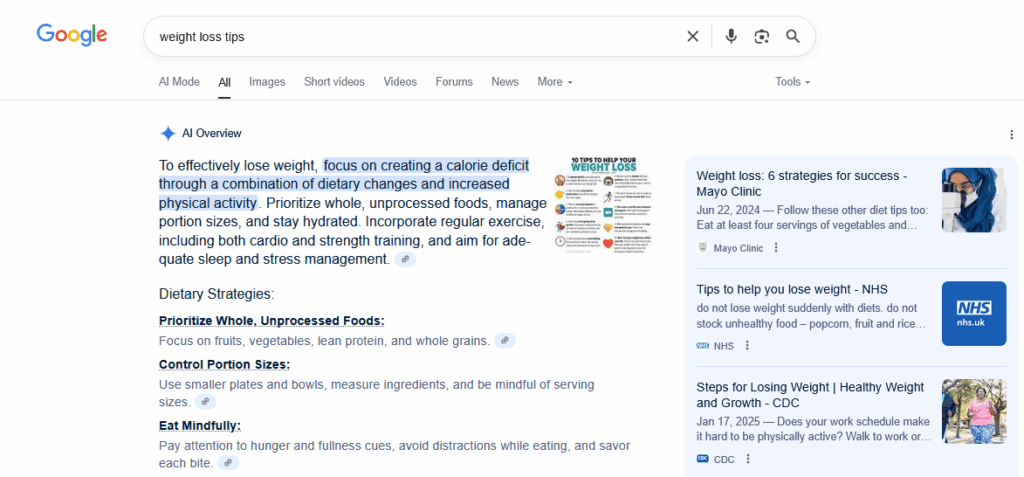
The Google AI Overview aims to directly answer users’ questions on the search engine results page (SERP). According to SEMRush, Google’s AI Overview now shows up in 13% of all this platform’s search results2.
It’s convenient for searchers and a huge headache for anyone who wants organic traffic from Google. Thankfully, instead of worrying about AI Overviews eating into your traffic, use this situation as an opportunity.
Content that’s structured clearly, provides key takeaways, and uses schema markup can actually be featured within Google’s AI Overview.
AI SEO Strategy 1: (AI-Resistant Content)
Leading AI models, including ones used by Google, are impressive. They can do a lot. However, AI can’t replicate:
- Personal stories or anecdotes
- Case studies
- Proprietary data
- Detailed tutorials
Besides gaining a potential edge over AI, you gain a competitive advantage by creating unique content that’s head and shoulders above generic guides and posts.
AI SEO Strategy 2: (Optimizing for Inclusion)
As they say, “If you can’t beat them, join them.” How can you help ensure your website’s content becomes BFFs with Google’s AI? Use these tips:
- Structure content clearly with H2 and H3 subheadings (bonus points if they contain relevant keywords)
- Include FAQs with FAQ-style formatting
- Answer questions fast (within the first or second sentence)
4. Focus on Semantic SEO and Topic Clusters
Semantic SEO goes deeper than keywords. It’s about the meaning behind those keywords. You must also focus on how well your content addresses a user’s intent (as we mentioned earlier).
Use semantic SEO best practices to:
- Find related concepts and include them naturally in your content.
- Create content that fully answers a topic, not just a few specifics.
- Strengthen your clusters with internal links.
Think of your website like a collection of video games or music. Topic clusters let you organize your content, which helps Google find what it’s looking for, so it can help searchers find what they’re searching for.
Looking to improve your SEO?
5. Content Depth and Authority
There’s no way around it: Surface-level content doesn’t cut it in 2025. Sticking to this way of making content will only lead to weeks or months spent waiting to gain traction in Google’s results. Most likely, even with an authoritative website, cracking page 1 won’t be easy.
So, how do you fix that problem? By using these SEO strategies:
- Writing long-form articles
- Clear, actionable advice backed by research or experience
- Expert-level insights, not fluff or the first thing an AI outputs
6. E-E-A-T (Experience, Expertise, Authoritativeness, Trustworthiness) Remains an SEO Best Practice

While it’s not a brand-new concept, E-E-A-T remains four vital letters to remember if you want SEO success in 2025. This abbreviation helps search engines assess content quality, especially in health and finance-related niches (Your Money, Your Life topics).
Strengthen your website’s E-E-A-T signals by:
- Including author bios with real credentials
- Citing only reputable sources
- Adding real-world examples to content
7. Use an Internal Linking Strategy
Using internal links properly is the dark horse of SEO strategies. It’s a smart move. However, the average brand isn’t using these links to their full potential.
Here’s how to get the most from internal links:
- Link from high-authority pages to newer ones to leverage page and post strength throughout your website.
- Use a blend of exact match, LSI, and descriptive anchor texts.
- Make topic clusters navigable through related article links.
8. Mobile-First Indexing
According to SEMRush, in 2023, mobile devices received 313% more visits compared to desktop computers across the many websites analyzed by SEMRush’s platform³. If your website isn’t mobile-optimized, you could be missing out on lots of traffic.
Audit your mobile experience:
- Always use responsive designs and templates.
- Avoid intrusive pop-ups.
- Compress images to minimize load times.
9. Data-Driven Decisions Beyond Volume
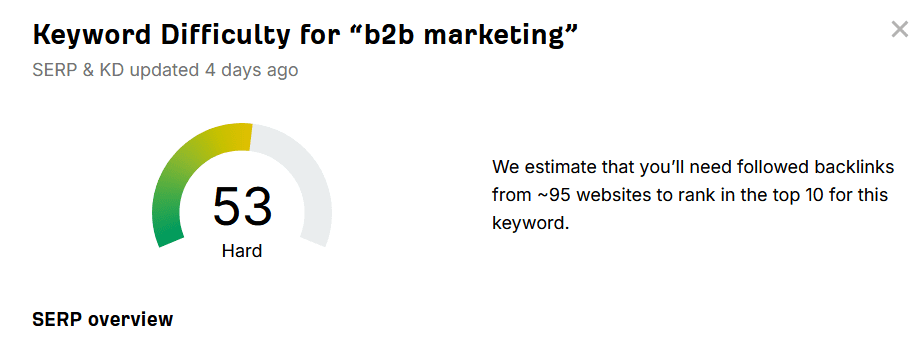
Search volume still matters. However, in 2025, it shouldn’t dictate your SEO strategy.
Analyze deeper metrics like:
- Conversion rate per keyword
- SERP features
- Engagement time
Get SEO Results on Autopilot with Coalition Technologies
Unless you have a time machine that goes back to 2012, the best strategies for SEO are not “set it and forget it.” However, with the right partner, it can feel that way for busy business owners. Coalition Technologies has our fingers firmly on the pulse of the world of SEO, including all-too-frequent algorithm updates from Google and social media websites. Get your free consultation today.