The Rundown
- Google AI mode picks passages, not pages: This means that your single well-crafted paragraph can beat someone’s entire homepage in AI responses.
- Micro-answer optimization is crucial: Every passage within your content should aim towards answering specific sub-questions with crystal clarity.
- Content format really matters for AI: Therefore, when learning how, or trying to optimize for Google AI, use bullet points, headers, schema markup, and so on.
- Zero-click optimization drives modern traffic strategy: With 58% of searches ending without clicks, getting featured in AI answers trumps traditional rankings.
- Partner with Coalition Technologies to keep your digital marketing strategy ahead of the curve.
Did you know that 58% of Google searches now result in zero clicks? That statistic from recent SparkToro research tells us everything we need to know about where search is heading.1 We’re witnessing the biggest shift in search behavior since Google launched two decades ago. At Coalition Technologies, we’ve been focusing on how to optimize sites for AI Overview and tracking this transformation closely while helping our clients stay ahead of it.
Here is the reality: traditional SEO strategies built around ranking entire pages are slowly dying out. Many Google searches now result in zero clicks, meaning most users find what they need without ever leaving the search results page. But here’s what most agencies won’t tell you: this isn’t a crisis. Learning how to optimize for Google AI is an opportunity for businesses smart enough to adapt.
Table of Contents
What Is Google AI Mode?
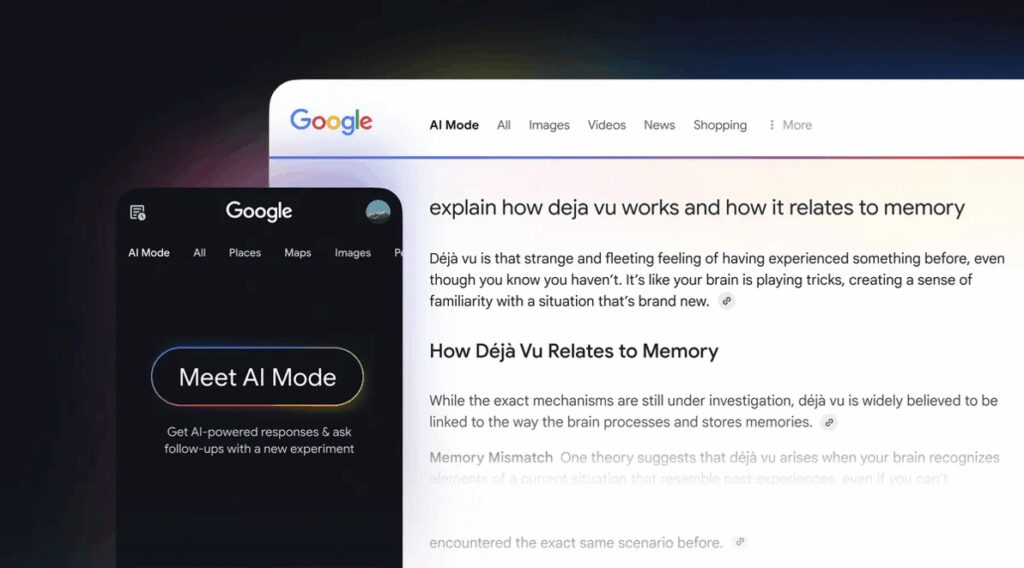
Google AI mode is simply a feature that helps people search for things more quickly, and learning how to optimize your site for this AI tool will help your brand continue to thrive on the web. It combines the advanced capabilities of Gemini 2.0 with Google’s best-in-class information systems so that instead of serving up links to different pages, it pulls together answers from different parts of the web and weaves them into one, conversational response.
It’s not just looking at full pages anymore. It’s digging into specific paragraphs, sometimes even deep inside a blog post or product page, and using them to piece together a bigger answer.
Say someone searches for “What’s the best CRM for SaaS Startups?” Google doesn’t just stop there, which is an advantage for those who know how to optimize for AI. In the background, it’s likely checking related questions like:
- What features matter most to startup teams?
- How well does HubSpot integrate with Slack?
- What’s the price breakdown across different CRMs?
And do you know what the best part is? You don’t need to rank at the top for that original query. If one of your paragraphs nails a follow-up question better than anyone else, you’re in. That small slice of your content might be the exact piece Google chooses to include in its AI-generated summary.
Why Traditional SEO Strategies Are Falling Short
As leaders in the SEO space, we’ve been here long enough to recognize significant changes when they happen, and focusing your strategy on optimizing for Google AI is crucial.
The old strategies focused on relevance, authority, and keyword density across entire pages. Of course, those fundamentals still matter, but they’re no longer enough. This is because, as we’ve said earlier, Google now selects content snippets from multiple sources, sometimes from sites that don’t even appear in traditional search results.
See what the numbers say. AI Overview occurrence in US SERPs reached 18.76% in November 20242, and early data suggests this will exceed 25% by the end of 2025. Meanwhile, businesses that are still clinging to outdated optimization strategies are watching their traffic erode.
What we’ve discovered is that companies that learn how to optimize for AI and embrace this passage-level optimization are actually seeing traffic increases. We therefore see why some people in this industry even go as far as to say that AI-driven SEO campaigns can lead to a 45% increase in organic traffic and a 38% increase in conversion rates for e-commerce businesses.

Understanding Micro-Answer Optimization
In our discussion on how to optimize for Google AI, we have been talking about different parts being pulled from various sources, but there is a name for it in the SEO space–Micro-Answer Optimization (Micro-AEO).
Anyone who wants to thrive in today’s SEO space and learn how to effectively optimize for Google AI has to embrace these Micro-AEOs. If you would think of your content like a well-organized reference library, then every paragraph in it must function as a complete, useful answer on its own.
Some Important Principles We Use Adhere To
- Clarity Over Complexity: We write passages that directly answer specific questions while avoiding industry jargon, except for instances where we can immediately define it.
- Structural Precision: We also use formatting elements like bullet points and tables because that helps the AI engines identify and extract information.
- Contextual Authority: When it comes to knowing how to optimize for AI, passages are the important point to focus on. We systematically structure most of the paragraphs in an article to include things that signal expertise to AI systems like relevant data, internal links, and brand mentions.
- Standalone Completeness: For us, each content section should make sense without requiring readers to consume the entire article.
Need help to get your brand cited by Google AI?
Proven Strategies for AI Optimization
We will now discuss a tactical approach you can use to get results. We’ve arrived at these strategies based on our work with several ecommerce clients.
1. Structure Content for Sub-Question Answers
Google breaks complex queries into smaller components. Therefore, you want to write content that anticipates and answers the mini-questions, not just the primary search term.
For example, “best email marketing platforms for ecommerce” should also address things like integration capabilities with Shopify or WooCommerce and so on.
2. Format Your Content Strategically
As we have already hinted above, when it comes to learning how to optimize for AI, clear formatting is what will make it easier for AI systems to identify and extract relevant information from your work. Use things like bullet points, subheadings, tables, bold text, and anything else you think could make your content better structured.
3. Authoritative Data Is Your Friend
So, use it. AI engines prioritize factual, well-sourced information. This is why you must include specific statistics, case studies, and measurable results throughout your content.
4. Optimize Technical Foundation
When learning how to optimize your site for Google AI, consider the technical aspect as well:
- Does your site load under 3 seconds?
- Do you have a mobile-responsive design?
- Do you use clean URL structures?
- Does your site have a comprehensive schema markup?
AI will always favor sites that are fast and well-structured. This is why your technical SEO is important.
5. Use Internal Linking to Build Topical Authority
Imagine how great it would be if the AI response was generated using different pages from your site. This would rank your site high in authority for that topic, and that’s what you want when optimizing your site for AI.
Therefore, connect related content to demonstrate expertise depth. If your Shopify optimization guide links to your conversion rate optimization services, that contextual relationship helps AI systems understand your authority.
6. When Writing, Don’t be a Robot
There are subtle differences between what sounds human and what’s robotic. AI models are getting really good at telling these differences apart. You have to keep your writing precise but natural, with personality and real insights.
Frequently Asked Questions
What exactly is Google AI Model?
It’s Google’s experimental search experience that generates synthesized answers using content passages from multiple sources instead of ranking complete pages.
Do we need to completely rewrite our existing content to be ranked by Google AI?
When optimizing for Google AI, starting from scratch is unnecessary. Just focus on your best-performing pages first, then restructure sections to tackle specific sub-sections with clearer answers.
Can we still rank in traditional Google Search?
Absolutely, and this is even better. AI optimization really strengthens traditional SEO because it improves content clarity and structure.
How important is schema markup for AI optimization?
Super important. Schema helps AI systems understand your content’s context, intent, and relationships to other information.
What’s the typical timeline for seeing AI optimization results?
Our clients usually notice the first improvements around 6 to 8 weeks, but the real traffic gains tend to kick in after 3 – 4 months of consistent optimization. However, results vary, so we can only speak for Coalition Technologies.
Real Coalition Technologies Case Study
Like we said earlier, we have several clients who were struggling and wanted to know how to optimize their sites for Google AI. Our client Captain Dave’s Dana Point Dolphin & Whale Watching Safari is one of them. If you were to google, “Where can I go whale watching in Dana Point?” Our client’s name is not only the first on the list but it’s also linked in the AI overview and it also ranks high in the traditional SEO results.
This client was struggling to rank organically for search terms on dolphins and whale watching. So our task was to make them overall more competitive from an SEO perspective.
Knowing how to optimize their site for AI was not by chance. We used the same strategies we have discussed here over a period of 5 months to restructure the site and make it highly relevant with topical authority on whale watching. After just 5 months with us, organic traffic went up by 50% and revenue increased by 52%3.
The Future Belongs to Smart Adaptation
As SEO keeps changing, Google is turning search into a conversation. Your content needs to jump into that conversation with something valuable to say. No more generic fluff, but with strategically structured, highly specific answers.
At Coalition Technologies, we’re already implementing new strategies we’ve learned on how to optimize sites for Google AI. We do this for ecommerce brands across dozens of industries and the results speak for themselves.
Now, we want to do the same for you. We can help you optimize for AI discoverability while maintaining strong traditional SEO performance. That’s what market leaders do, and that’s what we help our clients become.
Sources
- https://sparktoro.com/blog/2024-zero-click-search-study-for-every-1000-us-google-searches-only-374-clicks-go-to-the-open-web-in-the-eu-its-360/
- https://seranking.com/blog/ai-overviews-2024-recap-research/
- https://ctstaging.ctinternal.coalition.reviews/portfolio/captain-daves-dana-point-dolphin-whale-watching-safari